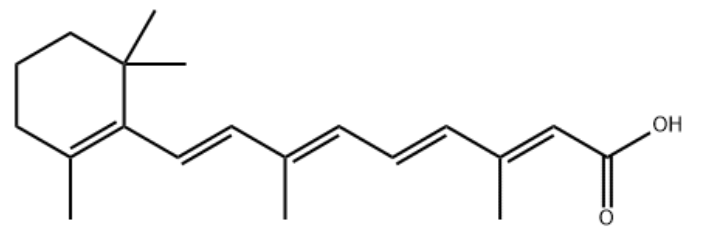
Retinoic acid #CAS302-79-4
Retinoic acid (TTA) is a commonly used dermatological drug. It is an intermediate metabolic product of vitamin A (vitamin A acetate) in the body, primarily affecting bone growth and epithelial metabolism. It promotes the proliferation and renewal of epithelial cells and inhibits the proliferation and differentiation of keratinocytes, restoring hyperkeratosis to normal. Therefore, it has a certain therapeutic effect on many diseases involving complete, incomplete, and excessive keratinization, and can treat various skin conditions. Topical application allows for rapid skin penetration, significantly increasing epithelial cell renewal. This class of drugs has a strong and rapid inhibitory effect on sebaceous gland secretion, reducing sebum production. In addition, it also has anti-tumor, wound-healing, and anti-infective effects.
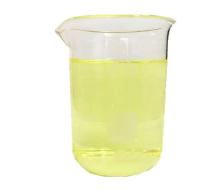
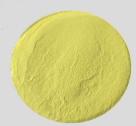
It appears as yellow needle-like crystals with an odor similar to vitamin A methyl acetate. It is readily soluble in methanol, ethanol, acetone, chloroform, and dichloromethane, and also soluble in vegetable oils and fats. It is unstable when exposed to light and heat, absorbs moisture from the air, and polymerizes and deteriorates upon contact with water. The melting point of all-trans retinoic acid is 180–182°C, and the melting point range is 170–190°C when mixed with a small amount of isomers.
Tretinoin is available in 10-mg capsules for oral administrationin the treatment of APL. The mechanism of action involvespassive diffusion through the cell membrane andthen movement to the nucleus where it interacts with theretinoic acid receptor (RAR) portion of the PML-RAR fusionprotein. Binding of tretinoin allows the cell to differentiateand has also been shown to result in the destruction ofthe PML-RAR fusion protein. Resistance to tretinoin isproblematic and associated with an increase in cellularretinoic acid–binding proteins (CRAPBs) located in the cytosol.The complexation with tretinoin prevents movementinto the nucleus and may present the drug to metabolizingenzymes that inactivate it. Amino acid mutation of thePML-RAR protein has also been established as a mechanismof resistance. The agent is well absorbed upon oral administrationand highly (95%) protein bound. Metabolismoccurs in the liver and several inactive metabolites havebeen identified including 13-cis-retinoic acid, 4-oxo cisretinoic,4-oxo trans-retinoic acid and 4-oxo trans-retinoicacid glucuronide. Elimination occurs in the urine (63%) andfeces (31%) with an elimination half-life of 40 to 120 minutes.Vitamin A toxicity is seen in nearly all patients andpresents as headache, fever, dryness of the skin, skin rash,mucositis, and peripheral edema. APL differentiation syndromesuch as that seen for arsenic trioxide also occurs.Cardiovascular effects include flushing, hypotension, CHF,stroke, and myocardial infarction have been reported butoccur only rarely. There are also several CNS and GI effectsthat have been associated with the agent as well.
Application of Retinoic acid
(1) Applies to abnormal tyshiyongyupe of acne, fish phosphorus disease and abnormal psoriasis.
(2) Resistance to abnormal skin drugs.
(3) Tretinoin mainly affects the growth of bones and epithelial metabolism, can promote epithelial cell proliferation and updates, and can inhibit the proliferation and differentiation of keratinocytes, so hyperkeratosis can be back to normal. Therefore many complete or incomplete keratosis, hyperkeratosis of diseases have a certain therapeutic effect, treat a variety of skin diseases. Tretinoin is mainly used in the treatment of psoriasis, ichthyosis, follicular keratosis, acne, lichen planus, verrucous epidermal nevus, impetigo, vitiligo, lichen psoriasis, the face of pityriasis alba, etc.
Retinoic acid (tretinoin) is a vitamin A derivative. It has demonstrated an ability to alter collagen synthesis, increase dermal hyaluronic acid levels, and stimulate fibroblast growth and the extracellular matrix. It is used for keratinization disorders and for treating acne. Retinoic acid’s anti-aging effect has been convincingly documented and it is often used for treating the visible signs of aging, though these results can take approximately 6 months to be visible. It is associated with a number of adverse effects, including irritation, photosensitivity, skin dryness, redness, and peeling. It should also not be used while pregnant.
| Retinoic acid Chemical Properties |
| Melting point | 180-181 °C (lit.) |
| Boiling point | 381.66°C (rough estimate) |
| density | 1.0597 (rough estimate) |
| refractive index | 1.4800 (estimate) |
| storage temp. | -20°C |
| solubility | Practically insoluble in water, soluble in methylene chloride, slightly soluble in ethanol (96 per cent). |
| pka | 4.73±0.33(Predicted) |
| form | powder |
| color | yellow |
| biological source | synthetic (organic) |
| Water Solubility | insoluble |
| Sensitive | Light Sensitive |
| Merck | 14,8165 |
| BRN | 2057223 |
| Stability: | Store Dry in Freezer at -20°C for up to 1 year; in Solution at -20°C for up to 3 Months. |
| Cosmetics Ingredients Functions | NOT REPORTED |
| InChI | 1S/C20H28O2/c1-15(8-6-9-16(2)14-19(21)22)11-12-18-17(3)10-7-13-20(18,4)5/h6,8-9,11-12,14H,7,10,13H2,1-5H3,(H,21,22)/b9-6+,12-11+,15-8+,16-14+ |
| InChIKey | SHGAZHPCJJPHSC-ZVCIMWCZSA-N |
| SMILES | CC1=C(\C=C\C(C)=C\C=C\C(C)=C\C(O)=O)C(C)(C)CCC1 |
| LogP | 6.300 |
| CAS DataBase Reference | 302-79-4(CAS DataBase Reference) |
| EPA Substance Registry System | Retinoic acid (302-79-4) |
| Safety Information |
| Hazard Codes | T,Xn,N |
| Risk Statements | 22-63-38-20/21/22-51/53 |
| Safety Statements | 53-26-36/37/39-45-36/37-61-24/25 |
| RIDADR | 3249 |
| WGK Germany | 3 |
| RTECS | VH6475000 |
| F | 7-8-16-23 |
| TSCA | TSCA listed |
| HazardClass | 6.1(b) |
| PackingGroup | III |
| HS Code | 29362100 |
| Storage Class | 6.1C - Combustible acute toxic Cat.3 toxic compounds or compounds which causing chronic effects |
| Hazard Classifications | Acute Tox. 4 Oral Aquatic Acute 1 Aquatic Chronic 1 Repr. 1B Skin Irrit. 2 |
| Hazardous Substances Data | 302-79-4(Hazardous Substances Data) |
| Toxicity | LD50 (10 day) in mice, rats (mg/kg): 790, 790 i.p.; 2200, 2000 orally (Kamm) |
Fact Factory and Equipment Show