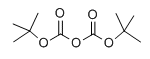
Di-tert-butyl dicarbonate #CAS24424-99-5
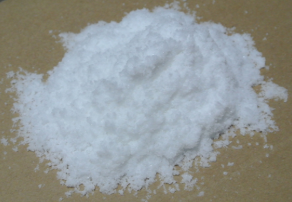
Di-tert-butyl dicarbonate (BOC Anhydride, DiBOC) is a colorless to white to yellow crystals, solidified mass or clear liquid. It melts around room temperature (m.p.=23°C). It does not decompose at this or even slightly higher temperatures. For example, it is typically purified by distillation under reduced pressure at temperatures up to around 65°C. At higher temperatures it will decompose to isobutene, t-butyl alcohol and carbon dioxide.
The reaction of substituted anilines with Boc2O in the presence of a stoichiometric amount of 4-dimethylaminopyridine (DMAP) in an inert solvent (acetonitrile, dichloromethane, ethyl acetate, tetrahydrofuran, toluene) at room temperature leads to aryl isocyanates in almost quantitative yields within 10 min.
Di-tert-butyl dicarbonate and 4-(dimethylamino)pyridine revisited. Their reactions with amines and alcohols
Di-tert-butyl dicarbonate (Boc2O) is a reagent mainly used for the introduction of the Boc protecting group to amine functionalities. It is also used as a dehydrating agent in some organic reactions, particularly with carboxylic acids, certain hydroxyl groups, or with primary nitroalkanes.
Application Of Di-tert-butyl dicarbonate
Di-tert-butyl dicarbonate (Boc2O) is a widely used reagent for introducing protecting groups in peptide synthesis. It plays an important role in the preparation of 6-acetyl-1,2,3,4-tetrahydropyridine by reacting with 2-piperidone. It serves as a protecting group used in solid phase peptide synthesis.
Di-tert-butyl dicarbonate has the following uses:
(1) As part of a series of bovine plasma amine oxidase inactivators. Aminomethylenes were prepared by the reaction of Boc propargylamine with formaldehyde, diisopropylamine and copper bromide.
(2) It can be used as a general purpose carboxylation reagent. Carbon nucleophiles generated by a non-nucleophilic base (LDA) were effectively trapped with di-tert-butyl dicarbonate (Boc-anhydride) to provide the corresponding tert-butyl aryl acetates, di-tert-butyl aryl malonates, unsymmetrical aryl malonates and tert-butyl benzoates in high yields.
(3) Alcohols as Boc derivatives were catalytically protected by Lewis acids. Reagents for the introduction of Boc protecting groups.
(4) Reagents for the preparation of Boc-protected amines. Tri-tert-butoxycarbonyl-protected hydrazines prepare Fmoc esters in chromogenic reagents for monitoring solid-phase aldehydes.
| Di-tert-butyl dicarbonate Chemical Properties |
| Melting point | 23 °C (lit.) |
| Boiling point | 56-57 °C/0.5 mmHg (lit.) |
| density | 0.95 g/mL at 25 °C (lit.) |
| vapor pressure | 3.85Pa at 25℃ |
| refractive index | n |
| Fp | 99 °F |
| storage temp. | 2-8°C |
| solubility | Chloroform (Sparingly), Methanol (Slightly) |
| form | Low Melting Crystalline Solid |
| color | White |
| Specific Gravity | 0.950 |
| Water Solubility | Miscible with decalin, toluene, carbon tetrachloride, tetrahydrofuran, dioxane, alcohols, acetone, acetonitrile and dimethylformamide. Immiscible with water. |
| Sensitive | Moisture Sensitive |
| BRN | 1911173 |
| Stability: | Acid Sensitive |
| Major Application | peptide synthesis |
| InChI | 1S/C10H18O5/c1-9(2,3)14-7(11)13-8(12)15-10(4,5)6/h1-6H3 |
| InChIKey | DYHSDKLCOJIUFX-UHFFFAOYSA-N |
| SMILES | CC(C)(C)OC(=O)OC(=O)OC(C)(C)C |
| LogP | 1.87 at 25℃ |
| CAS DataBase Reference | 24424-99-5(CAS DataBase Reference) |
| EPA Substance Registry System | Dicarbonic acid, bis(1,1-dimethylethyl) ester (24424-99-5) |
| Safety Information |
| Hazard Codes | T+,T,F,Xi,F+ |
| Risk Statements | 11-19-26-36/37/38-43-10-40 |
| Safety Statements | 16-26-28-36/37-45-7/9-37/39-24-36/37/39-33 |
| RIDADR | UN 2929 6.1/PG 1 |
| WGK Germany | 3 |
| RTECS | HT0230000 |
| F | 4.4-10-21 |
| Autoignition Temperature | 460 °C |
| Hazard Note | Flammable/Irritant/Very Toxic |
| TSCA | TSCA listed |
| HazardClass | 6.1 |
| PackingGroup | I |
| HS Code | 29209010 |
| Storage Class | 3 - Flammable liquids |
| Hazard Classifications | Acute Tox. 1 Inhalation Eye Dam. 1 Flam. Liq. 3 Skin Irrit. 2 Skin Sens. 1 STOT SE 3 |
| Toxicity | LD50 orally in Rabbit: > 5000 mg/kg LD50 dermal Rabbit > 2000 mg/kg |
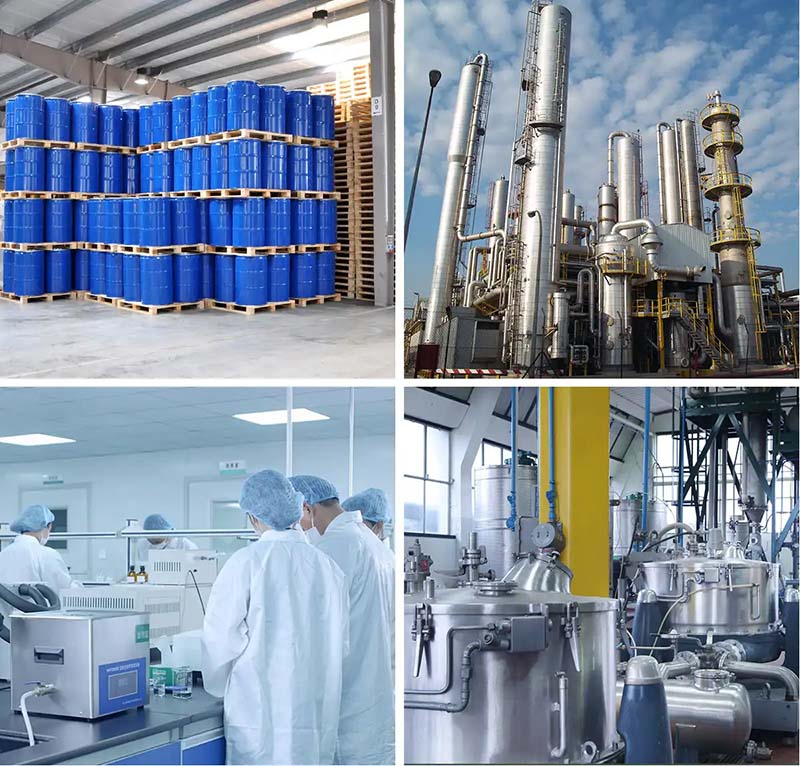
Fact Factory and Equipment Show