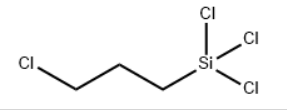
3-Chloropropyltrichlorosilane #CAS2550-06-3
CAS Number:2550-06-3
Chemical Formula:C3H6Cl4Si
Synonyms:
CC3291
3-Chloropropyltrichlorosilane, 97.5%
Dow Corning? product Z-6010
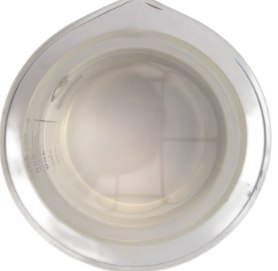
Appearance:Colorless to pale yellow transparent oily liquid at ambient temperature with pungent acrylic odor; violently hydrolyzes on contact with water releasing hydrogen chloride fumes, highly hygroscopic; Density:1.359g/cm³(25℃), B.P.178~183℃, F.P.84℃。
MOQ (Minimum Order Quantity): 1 FCL (Full Container Load)
3-Chloropropyltrichlorosilane #CAS2550-06-3
Colorless clear liquid
Non flammable
The synthesis of γ-chloropropyltrichlorosilane is made by silica-hydrogen addition reaction between trichlorohydrosilane and chloropropene under the action of precious metal compounds such as platinum, rhodium, palladium, etc. or complex catalysts, and industrial-grade γ-chloropropyltrichlorosilane can be obtained by distillation and separation of the reaction products. Currently available production methods mainly involve the dropwise addition of a mixture of chloropropylene and trichlorohydrosilane under atmospheric pressure for the reaction. For example, the State Intellectual Property Office on January 18, 2012 disclosed & ldquo; a & gamma;-chloropropyltrichlorosilane production method & rdquo; patent literature, introduced the & gamma;-chloropropyltrichlorosilane production method, using chloroplatinic acid - divinyltetramethyldisiloxane as a catalyst, protected by nitrogen gas with 14-16 hours from the high level tank to enameled The reaction was carried out by uniformly adding raw material trichlorohydrosilane and chloropropylene mixture dropwise from a high level tank into an enameled kettle under the protection of nitrogen for 14-16 hours. In addition, the State Intellectual Property Office on January 13, 2010 disclosed “ a multi-component composite catalytic method for the preparation of γ-chloropropyltrichlorosilane ” patent documents, using chloroplatinic acid isopropanol solution as the main catalyst, isophthalic acid, isobutylamine, isopropanol solution as a co-catalyst, in the 2000L kettle to add 750Kg of trichlorosilicone and 550kg of chloropropylene, the reaction was carried out under nitrogen protection in a high level tank to evenly add raw trichlorosilane and chloropropylene mixture. 550 kg of chloropropylene in a 2000L kettle, reacted at 50-55C for 4.5 hours, and then used 5.5 hours to raise the temperature to 81-84C to keep the reaction to prepare γ-chloropropyltrichlorosilane.
Application of 3-Chloropropyltrichlorosilane
γ-Chloropropyltrichlorosilane (Cl(CH2)3SiCl3) is one of the most important intermediates in the production of silane coupling agents. It can be used as the main raw material to produce silane coupling agents such as chloropropyltrieth(meth)oxysilane, aminopropyltrieth(meth)oxysilane, and bis(triethoxysilylpropyl)tetrasulfide, which are important additives in rubber products and glass fiber reinforcement materials.
| 3-Chloropropyltrichlorosilane Chemical Properties |
| Boiling point | 181 °C |
| density | 1.35 g/mL at 25 °C(lit.) |
| refractive index | 1.465 |
| Fp | 84°C |
| storage temp. | Inert atmosphere,Room Temperature |
| form | clear liquid |
| color | Colorless to Almost colorless |
| Specific Gravity | 1.35 |
| Hydrolytic Sensitivity | 8: reacts rapidly with moisture, water, protic solvents |
| Sensitive | Moisture Sensitive |
| BRN | 1737851 |
| InChI | InChI=1S/C3H6Cl4Si/c4-2-1-3-8(5,6)7/h1-3H2 |
| InChIKey | OOXSLJBUMMHDKW-UHFFFAOYSA-N |
| SMILES | [Si](Cl)(Cl)(Cl)CCCCl |
| CAS DataBase Reference | 2550-06-3(CAS DataBase Reference) |
| NIST Chemistry Reference | Silane, trichloro(3-chloropropyl)-(2550-06-3) |
| EPA Substance Registry System | Silane, trichloro(3-chloropropyl)- (2550-06-3) |
| Safety Information |
| Hazard Codes | C |
| Risk Statements | 14-34 |
| Safety Statements | 26-36/37/39-43-45 |
| RIDADR | 2987 |
| WGK Germany | WGK 1 |
| TSCA | TSCA listed |
| HazardClass | 8 |
| PackingGroup | II |
| HS Code | 29319090 |
| Storage Class | 8A - Combustible, corrosive hazardous materials |
| Hazard Classifications | Skin Corr. 1B |