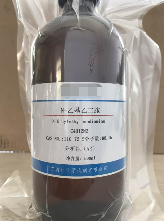
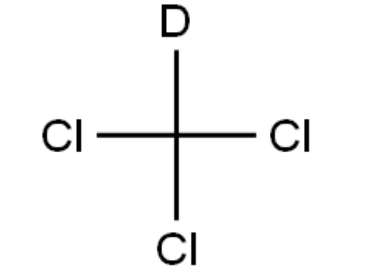
Chloroform-d #CAS865-49-6
Deuterated chloroform (CDCl3) is a deuterated derivative of chloroform, a deuterated solvent. It is a colorless liquid used in NMR (Nuclear Magnetic Resonance) instruments. Its use is due to its good chemical solubility in samples; its residual signal peaks do not interfere with the sample's signal peaks. The residual proton signal of deuterated chloroform is at 7.26 ppm; the possible residual water peak is at 1.56 ppm.
Deuterated chloroform is a reagent used in NMR instruments; it is also a raw material for organic synthesis, mainly used to produce Freon (F-21, F-22, F-23), dyes, and pharmaceuticals. In medicine, it is commonly used as an anesthetic. It can be used as a solvent and extractant for antibiotics, fragrances, oils, resins, and rubber. Mixed with carbon tetrachloride, it can form a non-freezing fire retardant. It is also used in propellants for smoke agents, fumigants for grains, and standard solutions for temperature calibration. Industrial products often contain a small amount of ethanol, which reacts with the generated phosgene to produce non-toxic diethyl carbonate. Before using industrial chloroform, a small amount of concentrated sulfuric acid can be added, shaken, and then washed with water. After drying with calcium chloride or potassium carbonate, ethanol-free chloroform can be obtained.
Deuterated chloroform (CDCl3), also known as chloroform-d, is an excellent everyday solvent choice for scientists who demand exceptional results. Commonly used as a solvent in proton NMR (1H NMR) spectroscopy, chloroform-d can dissolve a vast array of compounds with ease due to its weak polarity. It is often used in combination with methanol-d as a cosolvent. Plus, its low boiling point makes it relatively easy to recover a sample post-NMR analysis or during organic syntheses.
Application of Chloroform-d
Chloroform-d is widely used in the organic solvent for the NMR analysis.
Chloroform-d may be used in the synthesis of dichlorofluoromethane-d (DCFM).
| Chloroform-d Chemical Properties |
| Melting point | -63,5°C |
| Boiling point | 61-62°C |
| density | d = 1,5 |
| vapor pressure | 211 hPa (20 °C) |
| refractive index | n |
| Fp | 62°C |
| storage temp. | Store at +2°C to +8°C. |
| solubility | Miscible with organic solvents, ethyl acetate and acetone. |
| form | Liquid |
| color | White to beige |
| Specific Gravity | 1.505 |
| Water Solubility | 4.6g/L |
| Sensitive | Moisture Sensitive |
| BRN | 1697633 |
| Exposure limits | ACGIH: TWA 10 ppm OSHA: Ceiling 50 ppm(240 mg/m3) NIOSH: IDLH 500 ppm; STEL 2 ppm(9.78 mg/m3) |
| Stability: | Stable. Incompatible with strong bases, alkali metals, aluminium, magnesium, strong oxidizing agents. |
| InChI | 1S/CHCl3/c2-1(3)4/h1H/i1D |
| InChIKey | HEDRZPFGACZZDS-MICDWDOJSA-N |
| SMILES | [2H]C(Cl)(Cl)Cl |
| LogP | 1.5-1.6 at 20-23℃ and pH9 |
| Surface tension | 72.3mN/m at 998.5mg/L and 20℃ |
| CAS DataBase Reference | 865-49-6(CAS DataBase Reference) |
| EPA Substance Registry System | Chloroform-d (865-49-6) |
| Safety Information |
| Hazard Codes | Xn,T |
| Risk Statements | 22-38-40-48/20/22-48/20-36/38-20/22-63 |
| Safety Statements | 36/37 |
| RIDADR | UN 1888 6.1/PG 3 |
| WGK Germany | 2 |
| HazardClass | 6.1 |
| PackingGroup | III |
| HS Code | 28459000 |
| Hazard Classifications | Acute Tox. 3 Inhalation Acute Tox. 4 Oral Carc. 2 Eye Irrit. 2 Repr. 2 Skin Irrit. 2 STOT RE 1 Oral STOT SE 3 |
| Toxicity | LD50 orally in Rabbit: 695 mg/kg LD50 dermal Rabbit > 3980 mg/kg |
Fact Factory and Equipment Show

![1,5,7-Triazabicyclo[4.4.0]dec-5-ene #CAS5807-14-7](https://futiancdn.huazhi.cloud/cdn/ff/hnzj4q3HFH2F6vjyN_mc8vmTv1fhjVopQNWWBEkVnKU/1780559987/public/styles/chanp/public/2026-06/ScreenShot_2026-06-04_144653_731.png?itok=BwAJl4lo)