Potassium sorbate #CAS 24634-61-5
Potassium sorbate #CAS 24634-61-5
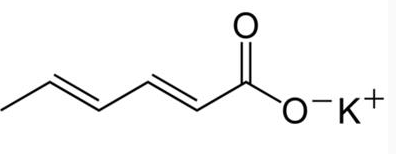
Chemically, sorbic acid is a straight chain, alpha beta-unsaturated, trans-trans 2,4 hexadienoic monocarboxylic acid (CH3-CH = CH-CH = CH-COOH). It has a molecular weight of 112 and a pKa value of 4.75. At room temperature sorbic acid is a white crystalline solid with a melting point range of 132°-137°C.
Its solubility in water at 25°C is 0.16% while that of its potassium salt is over 50%.
This higher solubility renders potassium sorbate a preferred form of sorbic acid in foods. In oils, however, sorbic acid is more soluble than the potassium salt.
Sorbic acid was first isolated from oil of unripened rown berries (sorbapple or mountain ash berry) by A. W. Hoffmann in 1859. The compound was named after the scientific name of mountain ash {Sorbus aucuparia}, which is the parent plant of rown berry. The chemical structure of sorbic acid was elucidated during 1870-1890 and it was synthesized in 1900 by Doebner by condensation of crotonalhyde and malonic acid.
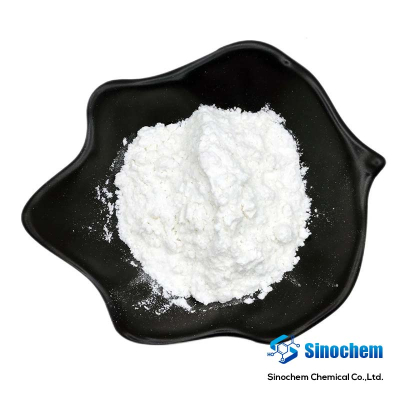
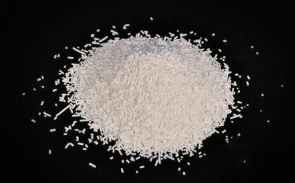
Potassium sorbate is a white crystalline powder. It is a potassium salt of sorbic acid.It was originally discovered in the 1850’s, and was derived from the Mountain Ash Tree. Today, potassium sorbate is synthetically created.Potassium sorbate is a good food preservatives, fully degradable, similar to fatty acids found naturally in foods. It is used to slow the growth of molds and yeasts in foods. It is commonly found in margarine, wines, cheeses, yogurts, soft drinks, and baked goods. Potassium sorbate has been used has a food preservative for many years. There have been extensive long-term tests that have confirmed its safety and it is on the Center for Science in the Public Interest list of safe additives.
Potassium sorbate is the potassium salt of sorbic acid, chemical formula C6H7KO2. Its primary use is as a food preservative (E number 202). Potassium sorbate is effective in a variety of applications including food, wine, and personal care products. Commercial sources are now produced by the condensation of crotonaldehyde and ketene.
Application of Potassium Sorbate
Potassium sorbate is used to inhibit molds and yeasts in many foods, such as cheese, wine, yogurt, dried meats, apple cider, soft drinks and fruit drinks, and baked goods. It can also be found in the ingredients list of many dried fruit products. In addition, herbal dietary supplement products generally contain potassium sorbate, which acts to prevent mold and microbes and to increase shelf life, and is used in quantities at which there are no known adverse health effects, over short periods of time.Labeling of this preservative on ingredient statements reads as "potassium sorbate" and or "E202". Also, it is used in many personal care products to inhibit the development of microorganisms for shelf stability. Some manufacturers are using this preservative as a replacement for parabens.
Also known as "wine stabilizer", potassium sorbate produces sorbic acid when added to wine. It serves two purposes. When active fermentation has ceased and the wine is racked for the final time after clearing, potassium sorbate will render any surviving yeast incapable of multiplying. Yeast living at that moment can continue fermenting any residual sugar into CO2 and alcohol, but when they die no new yeast will be present to cause future fermentation.
Sorbic acid is a naturally occurring polyunsaturated fat that has antimicrobial properties. That means that it helps to prevent the growth of molds, yeasts, and fungus. Potassium sorbate is found in many food products, especially those which are meant to be stored and eaten at room temperature. This helps to ward off particles such as mold or fungus that can cause foods to spoil or make people sick. Baked goods, processed fruits and vegetables or dairy products frequently contain this product. When brewing wine, yeast is used to convert sugar to alcohol. This process is called fermentation. When the wine reaches the desired flavour and body, you want to stop the yeast from growing. Potassium sorbate is added to inhibit yeast growth.
As mold and yeast inhibitor, like sorbic acid, especially where greater soly in water is desirable.
Sorbic acid and its potassium salt is commonly employed as food preservative in wide range of foodstuffs, such as cheese, pickles, sauces and wines.
Potassium sorbate is a food grade preservative generally regarded as safe (GRAS) worldwide. It is the inactive salt of sorbic acid. It readily dissolves in water where it converts to sorbic acid, its active form, at a low pH. Sorbic acid is very pH dependent. While it shows some activity up to pH 6 (about 6%), it is most active at pH 4.4 (70%). At pH 5.0 it is 37% active. As sorbic acid, it is considered to be active against mold, fair against yeast and poor against most bacteria. Sorbic acid is an unsaturated fatty acid and as such is subject to oxidation (use of an antioxidant like Mixed Tocopherols T50 is recommended). It is also sensitive to UV light and may turn yellow in solution. Gluconolactone is reported to stabilize potassium sorbate against discoloration and darkening in aqueous solutions and may be useful in stabilizing sorbic acid in the water phase of a product.
| Potassium sorbate Chemical Properties |
| Melting point | 270 °C |
| density | 1,361 g/cm3 |
| vapor pressure | <1 Pa (20 °C) |
| FEMA | 2921 | POTASSIUM SORBATE |
| storage temp. | 2-8°C |
| solubility | H2O: 1 M at 20 °C, clear, colorless to faintly yellow |
| form | Powder |
| pka | 4.69[at 20 ℃] |
| color | White to light cream |
| Odor | Odorless |
| PH Range | 8 - 11 at 580 g/l at 20 °C |
| PH | 7.8 (H2O, 20.1℃) |
| Water Solubility | 58.2 g/100 mL (20 ºC) |
| Merck | 14,7671 |
| BRN | 5357554 |
| Stability: | Stable. Incompatible with strong oxidizing agents. |
| Major Application | cleaning products cosmetics food and beverages personal care |
| Cosmetics Ingredients Functions | FRAGRANCE PRESERVATIVE |
| InChI | 1S/C6H8O2.K/c1-2-3-4-5-6(7)8;/h2-5H,1H3,(H,7,8);/q;+1/p-1/b3-2+,5-4+; |
| InChIKey | CHHHXKFHOYLYRE-STWYSWDKSA-M |
| SMILES | [K+].C\C=C\C=C\C([O-])=O |
| LogP | -1.72 at 20℃ |
| CAS DataBase Reference | 24634-61-5(CAS DataBase Reference) |
| EPA Substance Registry System | Potassium sorbate (24634-61-5) |
| Safety Information |
| Hazard Codes | Xi,C,T,F |
| Risk Statements | 36/37/38-35-22 |
| Safety Statements | 26-36-45-36/37/39 |
| WGK Germany | 1 |
| RTECS | WG2170000 |
| Autoignition Temperature | >150 °C |
| TSCA | TSCA listed |
| HS Code | 2916 19 95 |
| Storage Class | 11 - Combustible Solids |
| Hazard Classifications | Eye Irrit. 2 |
| Toxicity | LD50 orally in Rabbit: 3800 mg/kg |
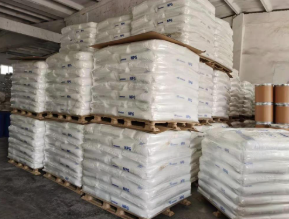
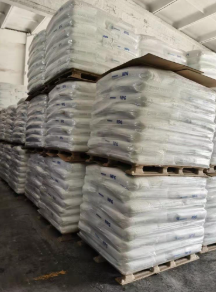
Fact Factory and Equipment Show