Cobalt oxide #CAS1307-96-6
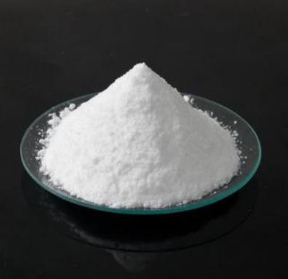
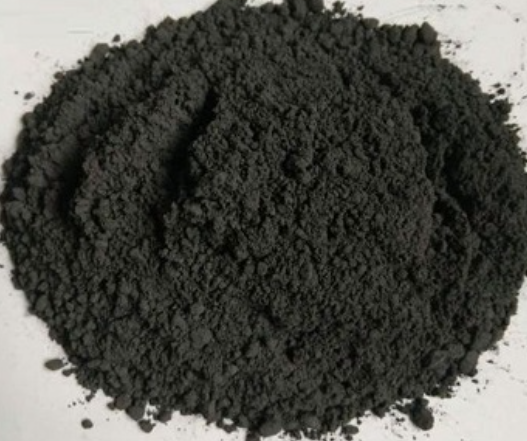
Cobalt oxide is a high-valence oxide of cobalt, with a theoretical cobalt content of 71.06% and an oxygen content of 28.94%. It is a black amorphous powder. Cobalt oxide is an unstable compound that cannot exist in a free state; usually, cobalt oxide contains a certain amount of cobalt tetroxide (cobalt trioxide), which is reduced to cobalt tetroxide upon heating. Cobalt tetroxide has a theoretical cobalt content of 73.43% and an oxygen content of 26.57%, and appears as a grayish-black or black powder. The cobalt oxide used in batteries is cobalt tetroxide, which has a spinel structure. It can be used as a negative electrode material for lithium-ion batteries and is also a major raw material for preparing lithium cobalt oxide, the positive electrode material for lithium-ion batteries.
This is obtained as an olive-green powder by heating the metal in air or steam or by thermal decomposition of the hydroxide, carbonate or nitrate. It has the sodium chloride lattice and is antiferromagnetic below 292°K. When heated in oxygen above 400° the black oxide Co3O4 is obtained. This oxide is isomorphous with magnetite Fe3O4, and has tetrahedrally surrounded cobalt(II) ions and octahedrally surrounded cobalt(III) ions. Both these oxides are readily reduced to the metal by heating in hydrogen or with carbon. The reactions of CoO with silica, alumina and zinc oxide are used to form pigments in the ceramic industry.
Application of Cobalt oxide
Cobalt(II) oxide is used as a pigment for ceramics and paints; for drying paints, varnishes and oils; for coloring glass; as a catalyst; and for preparation of other cobalt salts. The commercial product is a mixture of cobalt oxides.
In pigments for ceramics; glass coloring and decolorization; oxidation catalyst for drying oils, fast-drying paints and varnishes; preparation of cobalt-metal catalysts, Co powder for binder in sintered tungsten carbide; in semiconductors.
Cobalt oxide, typically 3.4-4.5%, Molybdenum oxide typically 11.5-14.5% on alumina is used in the preparation of biofuel production by using algae.
| Cobalt oxide Chemical Properties |
| Melting point | 1785 °C |
| density | 6.45 |
| bulk density | 0.966g/cm3 |
| vapor pressure | 0Pa at 20℃ |
| storage temp. | Store at room temperature, keep dry and cool |
| solubility | insoluble in H2O; soluble in acid solutions |
| form | Powder |
| Specific Gravity | 6.45 |
| color | Green-brown |
| Water Solubility | insoluble |
| Thermal Conductivity | 10.042 W/(m·K) |
| Sensitive | Air Sensitive |
| Crystal Structure | NaCl type |
| crystal system | Cube |
| Merck | 14,2446 |
| Space group | Fm3m |
| Lattice constant | a/nmb/nmc/nmα/oβ/oγ/oV/nm30.42630.42630.42639090900.0775 |
| Exposure limits | ACGIH: TWA 1 mg/m3 OSHA: TWA 15 mg/m3; TWA 5 mg/m3 |
| Stability: | Stability Stable, but may be moisture sensitive. |
| Major Application | battery manufacturing |
| InChI | InChI=1S/Co.O |
| InChIKey | IVMYJDGYRUAWML-UHFFFAOYSA-N |
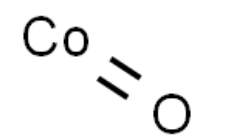
| SMILES | O=[Co] |
| CAS DataBase Reference | 1307-96-6(CAS DataBase Reference) |
| NIST Chemistry Reference | Cobalt monoxide(1307-96-6) |
| EPA Substance Registry System | Cobalt(II) oxide (1307-96-6) |
| Safety Information |
| Hazard Codes | Xn,N,T+ |
| Risk Statements | 22-43-50/53-42/43-26 |
| Safety Statements | 24-37-60-61-45-36/37-28 |
| RIDADR | UN 3288 6.1/PG 3 |
| WGK Germany | 3 |
| RTECS | GG2800000 |
| TSCA | TSCA listed |
| HazardClass | 6.1(b) |
| PackingGroup | III |
| HS Code | 28220000 |
| Storage Class | 6.1A - Combustible acute toxic Cat. 1 and 2 very toxic hazardous materials |
| Hazard Classifications | Acute Tox. 2 Inhalation Acute Tox. 3 Oral Aquatic Acute 1 Aquatic Chronic 1 Carc. 1B Inhalation Repr. 1B Resp. Sens. 1B Skin Sens. 1B |
| Hazardous Substances Data | 1307-96-6(Hazardous Substances Data) |
| Toxicity | LD50 orally in rats: 1.70 g/kg (Smyth) |
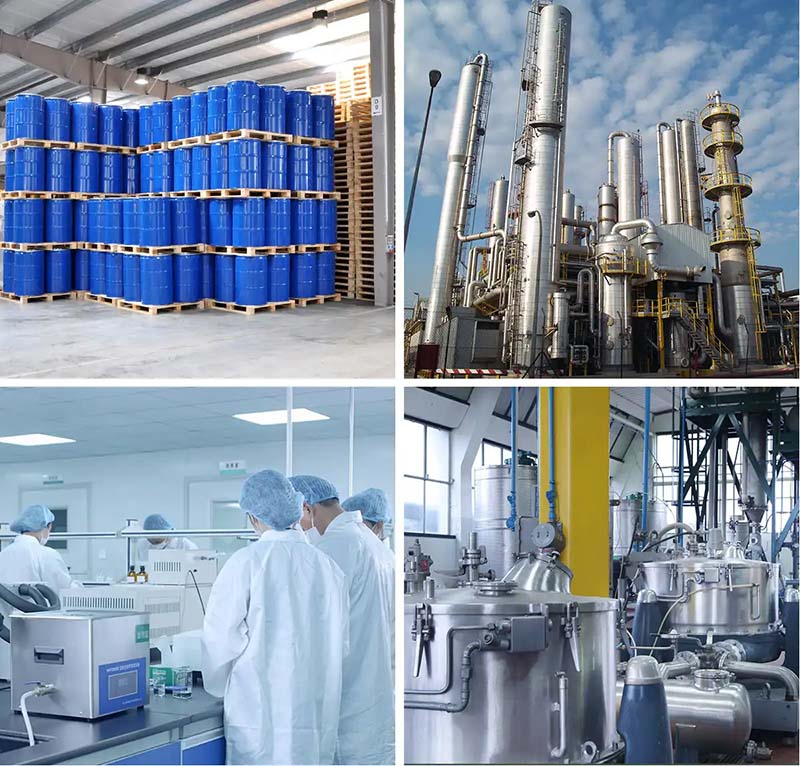
Fact Factory and Equipment Show