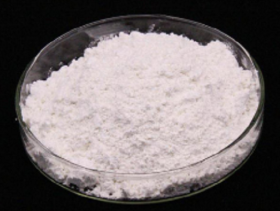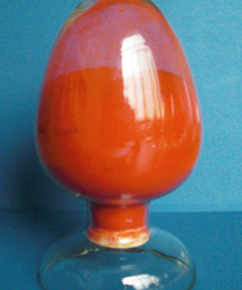
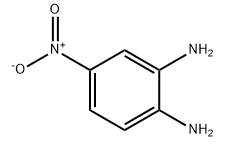
4-Nitro-o-phenylenediamine #CAS99-56-9
Dark red needle-like crystals. Melting point 201℃. Soluble in ethanol, acetone and hydrochloric acid solution, but insoluble in water.
It has a significant weak alkalinity and can react with inorganic acids (such as hydrochloric acid) to form soluble salts; as an aromatic primary amine, it can undergo acylation reactions with carboxylic acids, acid anhydrides or acyl chlorides, and can undergo ring formation reactions with aldehydes, ketones or double carbonyl compounds through adjacent diamines. It is often used in the synthesis of heterocyclic core structures such as benzimidazole or quinolone. Affected by the electron-withdrawing effect of the nitro group, the electrophilic substitution activity of the benzene ring is reduced, and this substance has obvious compatibility contraindications with strong oxidants, strong reductants, and acid anhydrides. In addition, this compound is a combustible substance. When heated, it will release smoke containing toxic nitrogen oxides (NOₓ), which has certain acute oral toxicity and potential skin allergic reactions.
Application Of 4-Nitro-o-phenylenediamine
4-Nitro-o-phenylenediamine was used to study the in vitro activation of 4-nitro-o-phenylenediamine into a potent mutagen in Salmonella typhimurium strain TA98 .
4-Nitro-1,2-phenylenediamine is a hair dye constituent with potential mutagenic activity. It is used in oxidation hair dye formulations at a maximum concentration of 1.0 %, which after mixing typically in a 1:1 ratio with hydrogen peroxide just prior to use, corresponds to a concentration of 0.5% upon application.
It is mainly used as a key intermediate for dyeing and pharmaceutical synthesis, especially as the coloring component of permanent hair coloring agents in the hair coloring agent industry, providing deep brown, black and red tones. In the field of fine chemicals, it takes advantage of its unique para-substitution cyclization property and is widely used in the manufacture of efficient pesticide fungicides (such as carbendazim, benomyl), high molecular light stabilizers, and high-end plastic and leather dyes. Moreover, due to its excellent photoelectric response characteristics, it is also used as a core functional monomer in the research and industrial production of new nonlinear optical materials and sensitive chemical sensors (such as heavy metal ion detection).
| 4-Nitro-o-phenylenediamine Chemical Properties |
| Melting point | 199-201 °C (lit.) |
| Boiling point | 276.04°C (rough estimate) |
| density | 1.3682 (rough estimate) |
| refractive index | 1.6910 (estimate) |
| storage temp. | Keep in dark place,Inert atmosphere,Room temperature |
| solubility | 1 N HCl: ethanol, 1:1: soluble50mg/mL |
| form | Powder |
| pka | 2.06±0.10(Predicted) |
| color | Brown-red |
| Water Solubility | 1.2 g/L (20 ºC) |
| Merck | 14,6622 |
| BRN | 608106 |
| Henry's Law Constant | 1.3×10⁶ mol/(m3Pa) at 25℃, HSDB (2015) |
| Stability: | Stable. Incompatible with strong acids, strong reducing agents, strong oxidizing agents, acid chlorides, acid anhydrides. |
| Cosmetics Ingredients Functions | HAIR DYEING |
| Cosmetic Ingredient Review (CIR) | 4-Nitro-o-phenylenediamine (99-56-9) |
| InChI | 1S/C6H7N3O2/c7-5-2-1-4(9(10)11)3-6(5)8/h1-3H,7-8H2 |
| InChIKey | RAUWPNXIALNKQM-UHFFFAOYSA-N |
| SMILES | Nc1ccc(cc1N)[N+]([O-])=O |
| CAS DataBase Reference | 99-56-9(CAS DataBase Reference) |
| IARC | 3 (Vol. 16, Sup 7) 1987 |
| EPA Substance Registry System | Nitro-o-phenylenediamine (99-56-9) |
| Safety Information |
| Hazard Codes | Xn |
| Risk Statements | 22-43-68-40-36/37/38-20/21/22 |
| Safety Statements | 36/37-45-36-26-22 |
| RIDADR | 2811 |
| WGK Germany | 3 |
| RTECS | ST2975000 |
| TSCA | TSCA listed |
| HazardClass | 6.1 |
| PackingGroup | II |
| HS Code | 29215119 |
| Storage Class | 11 - Combustible Solids |
| Hazard Classifications | Acute Tox. 4 Oral Skin Sens. 1 |
| Hazardous Substances Data | 99-56-9(Hazardous Substances Data) |
| Toxicity | LD50 oral in rat: 681mg/kg |
Fact Factory and Equipment Show

![1,5,7-Triazabicyclo[4.4.0]dec-5-ene #CAS5807-14-7](https://futiancdn.huazhi.cloud/cdn/ff/hnzj4q3HFH2F6vjyN_mc8vmTv1fhjVopQNWWBEkVnKU/1780559987/public/styles/chanp/public/2026-06/ScreenShot_2026-06-04_144653_731.png?itok=BwAJl4lo)